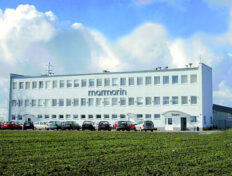
Two new production buildings at the Sélestat site
Around 1.3 million kitchens are bought in this country every year (Quelle- Destatis) – and for well over half of them the price was over 10,000 euros. A circumstance that has been reflected in the Schmidt Groupe’s steadily increasing turnover for years. But true to the motto “We won’t stay good if we don’t get better and better”, Europe’s fifth largest kitchen manufacturer is continuing its development strategy on a sustainable basis. At the Sélestat site, for example, production capacities have been continuously expanded with the new production buildings U3 and U2b. Over the past five years, the Group has invested around 165 million euros in its state-of-the-art furniture factories alone. These 700 kitchens produce every day and eleven are ready every 15 minutes.
The high degree of automation of its production processes is a key factor in the competitiveness of the Schmidt Groupe, which employs around 100 in-house IT engineers. For example, the specialist for customized furniture has already won the “L’Usine Digitale” award for the best digital factory and company in France. The U3 production facility, which costs 52 million euros, can therefore justifiably call itself one of the most highly automated furniture factories in the world. More than 40 robots are used here, which “listen” to individual names like “Lucky Luke” or “Pluto”.
On 18,700 square meters, panels and fronts are produced primarily for living rooms, but also for kitchens. Unlike in U1, a three-cut method is used here. There is no first vertical and then horizontal processing, but three cuts are made at once. “While avoiding unnecessary waste, the best possible optimization of the furniture parts produced in ‘batch size one’ plays an important role,” explains Jean-Claude Meyer, Managing Director of Schmidt Küchen GmbH & Co. KG, WHICH BELONGS TO THE SCHMIDT GROUPE. The high-tech factory became necessary because the French industry leader is able to record an annual growth rate of around 20 percent in the area of home furnishings.
“It takes about five years until all production lines are fully up and running and a hall is fully equipped. We are currently producing 8,000 parts here, the target is 12,000 a day,” explains Meyer. He expects to be ready in two years. U3 will then have 65 employees. There will even be a gym available for them and their colleagues from the other plants.
U2b was also built in Sélestat to optimize and increase production capacity. It is a 20,880 square meter extension building on the site of the Unit 2 plant – a mirror image of its neighbor U2, so to speak. Currently, 42 million euros have already been invested here. However, it will probably take until 2025 before U2b is fully utilised, which means that a total of 74 million euros would be spent on it. Once all production lines have been set up, this additional hall will provide 150 employees with a workplace, who will then produce 250 to 300 kitchens per day. Currently only 20 people are employed in production.
“The aim of the new building is to increase the volume of furniture assembly at the Sélestat site in order to meet the steadily increasing activity of our sales network,” says Meyer, explaining the innovation drive that has taken place. The traditional company, now in its third generation and managed by Anne Leitzgen, has a total production area of around 210,000 square meters, mainly in Alsace – three plants are located in Sélestat, one at the headquarters in Lièpvre, and in addition there is the parent company in the Saarland turquoise mill, which operates in a production network. There is also a logistics center in Bergheim. In October 2020, Schmidt was awarded the “Responsible Supplier Relations and Purchasing” label by the French Ministry of Economics for the fifth time in a row.